Open Plan vs Closed Plan Homes: Which Interior Design Works Best in India?
Every home begins with a layout decision. Not just where walls go, but how life flows inside those walls.
One of the most common questions homeowners face today is this. Should you choose an open plan or a closed plan layout?
If you are exploring open plan vs closed plan interior design, you are really deciding how your home will function every day. How you interact with family. How you use space. How comfortable your home feels.
At Zenway Spaces, layout decisions are not based on trends. They are based on how you live.
Understanding Open Plan and Closed Plan Layouts
Before choosing, it is important to understand what each layout means.
What Is an Open Plan Layout
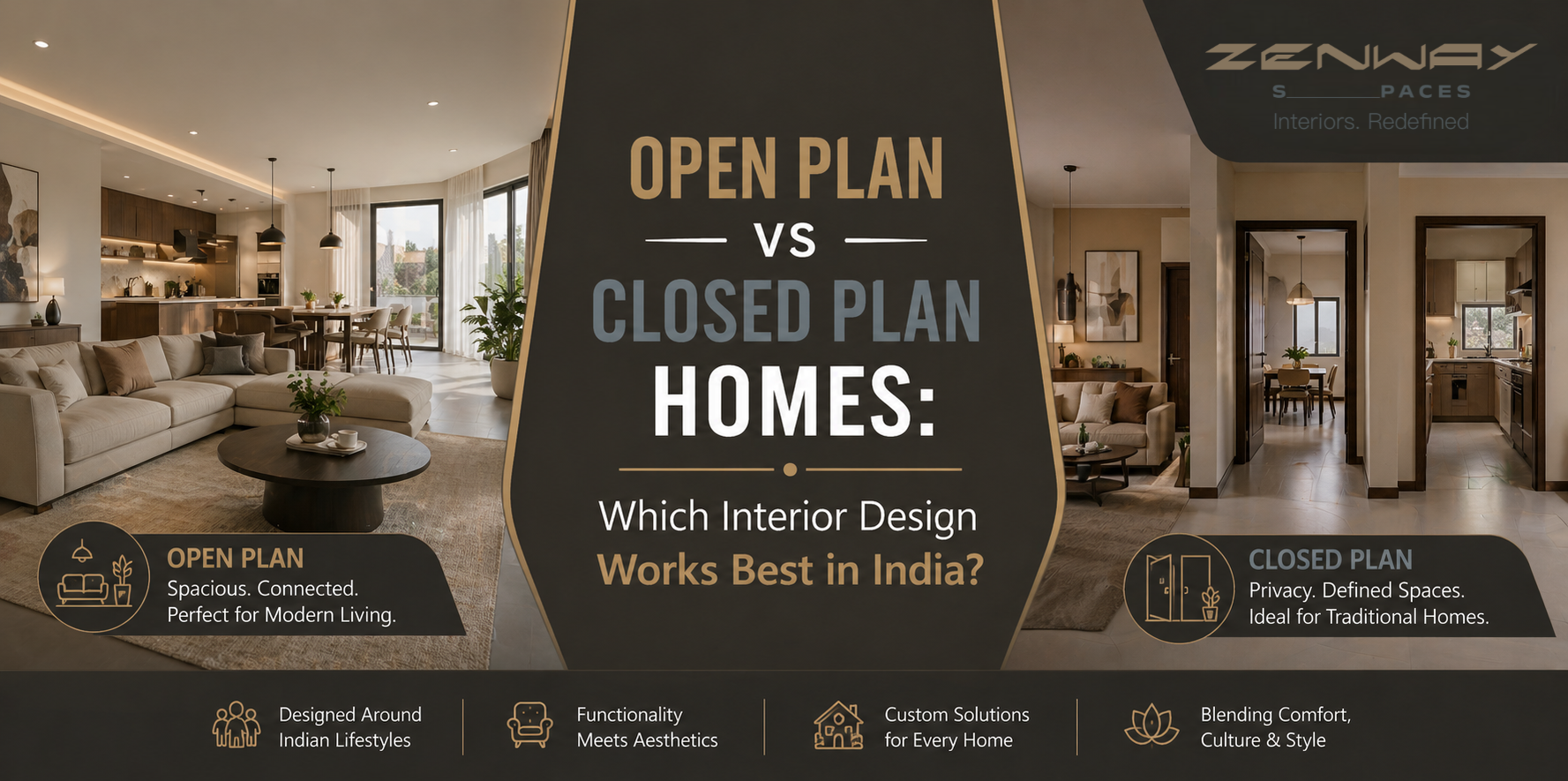
An open floor plan India design removes walls between key areas.
Typically, it connects:
-
Living room
-
Dining area
-
Kitchen
The idea is to create one continuous space.
What Is a Closed Plan Layout
A closed plan layout divides spaces with walls.
Each room has a defined function:
-
Separate living room
-
Separate kitchen
-
Separate dining space
This approach offers more structure and privacy.
Why This Decision Matters in Indian Homes
The choice between open plan vs closed plan interior design is especially important in India.
Indian homes have unique needs:
-
Cooking habits
-
Family size
-
Cultural preferences
-
Space constraints
What works in one home may not work in another.
Zenway Spaces focuses on understanding these factors before recommending a layout.
Advantages of Open Plan Homes
Open layouts are becoming popular in modern interior styles.
1. More Spacious Feel
Removing walls creates a sense of openness.
Even smaller homes feel larger with an open floor plan India approach.
2. Better Natural Light
Light flows across spaces without barriers.
This improves brightness and reduces the need for artificial lighting.
3. Improved Social Interaction
Open layouts allow:
-
Easy communication
-
Better visibility
-
More connected living
This works well for families and social gatherings.
4. Flexible Use of Space
An open layout allows multiple uses:
-
Living and working
-
Dining and relaxing
This flexibility supports modern lifestyles.
Challenges of Open Plan Homes
While exploring open plan vs closed plan interior design, it is important to consider limitations.
1. Lack of Privacy
Open spaces reduce separation.
This may not suit large families or work-from-home needs.
2. Kitchen Visibility
In Indian homes, cooking involves:
-
Strong aromas
-
Frequent use
An open kitchen means everything is visible.
3. Noise Levels
Without walls, sound travels easily.
This can affect comfort.
4. Need for Better Design Planning
Open layouts require:
-
Clear zoning
-
Thoughtful furniture placement
Without planning, the space can feel chaotic.
Zenway Spaces ensures proper zoning in open layouts to maintain balance.
Advantages of Closed Plan Homes
Closed layouts remain common in India.
1. Better Privacy
Separate rooms provide:
-
Personal space
-
Quiet environments
This is useful for families with different routines.
2. Functional Separation
Each space has a clear purpose.
This makes daily activities more organised.
3. Controlled Cooking Environment
Closed kitchens help contain:
-
Heat
-
Smell
-
Mess
This suits traditional cooking styles.
4. Noise Control
Walls reduce sound movement.
This improves comfort in multi-use homes.
Challenges of Closed Plan Homes
While analysing open plan vs closed plan interior design, closed layouts also have limitations.
1. Smaller Visual Space
Walls can make rooms feel compact.
2. Limited Natural Light Flow
Light stays restricted to individual rooms.
3. Less Flexibility
Changing room functions becomes harder.
Which Works Better for Indian Homes
There is no one answer.
The right choice depends on:
-
Your lifestyle
-
Family size
-
Home size
-
Cooking habits
Zenway Spaces does not follow a fixed rule. The focus is on what works best for you.
Hybrid Layout: The Practical Solution
Many modern homes now use a mix.
A hybrid approach combines:
-
Open living and dining areas
-
Semi-closed or closed kitchens
-
Defined private spaces
This balances openness with functionality.
In many interior layout comparison cases, hybrid designs work best for Indian homes.
Small Home Design Tips for Layout Planning
If you have limited space, layout becomes even more important.
Here are practical small home design tips:
1. Use Partial Partitions
Instead of full walls, use:
-
Glass partitions
-
Sliding panels
-
Open shelves
This maintains openness while defining space.
2. Focus on Zoning
Even in open layouts, create zones using:
-
Rugs
-
Lighting
-
Furniture
Zenway Spaces uses zoning to improve clarity in open designs.
3. Prioritise Storage
Clutter affects both layouts.
Smart storage is essential in small home design tips.
4. Use Light Colours
Light colours make spaces feel larger.
How Zenway Spaces Approaches Layout Design
Zenway Spaces stands out in open plan vs closed plan interior design by focusing on real-life usage.
1. Understanding Your Routine
The design begins with:
-
How you cook
-
How you work
-
How your family interacts
2. Creating Functional Flow
Spaces are designed to:
-
Connect naturally
-
Avoid unnecessary movement
3. Balancing Openness and Privacy
Zenway Spaces often recommends hybrid layouts that combine the best of both approaches.
4. Designing for Long-Term Use
Layouts are planned for:
-
Future needs
-
Changing lifestyles
Common Mistakes in Layout Planning
Avoid these while choosing between open plan vs closed plan interior design:
-
Following trends without understanding usage
-
Ignoring cooking habits
-
Overlooking storage needs
-
Not planning for noise and privacy
Zenway Spaces ensures these factors are addressed early.
Cost Considerations
Layout decisions can impact cost.
Open layouts may require:
-
Structural changes
-
Custom furniture
Closed layouts may involve:
-
Additional walls
-
Separate lighting setups
A clear interior layout comparison helps plan budgets better.
Zenway Spaces provides clarity in cost planning.
The Role of Full Home Design
Layout decisions affect the entire home.
A strong full home design ensures:
-
Consistent flow
-
Balanced spaces
-
Better functionality
Zenway Spaces integrates layout planning into overall design.
Final Thoughts
Choosing between open plan vs closed plan interior design is not about what is better.
It is about what fits your life.
Open layouts offer:
-
Openness
-
Flexibility
-
Modern feel
Closed layouts offer:
-
Privacy
-
Structure
-
Control
The best solution often lies in balance.
Zenway Spaces helps homeowners find that balance by designing spaces that feel natural, functional, and easy to live in.
Frequently Asked Questions
1. What is open plan vs closed plan interior design?
Open plan vs closed plan interior design compares layouts with connected spaces versus separate rooms. Zenway Spaces helps choose the right option based on your lifestyle.
2. Is an open floor plan India suitable for all homes?
No. An open floor plan India works well for smaller homes and social spaces, but may not suit heavy cooking or privacy needs. Zenway Spaces suggests balanced solutions.
3. Which layout is better in an interior layout comparison?
In an interior layout comparison, both layouts have advantages. Zenway Spaces often recommends hybrid layouts for Indian homes.
4. What are the best small home design tips for layout planning?
Key small home design tips include zoning, smart storage, and using light colours. Zenway Spaces ensures small spaces feel open and functional.
5. Can layout planning be part of full home design?
Yes. Layout is a core part of full home design. Zenway Spaces integrates layout decisions into the overall home plan for better results.